
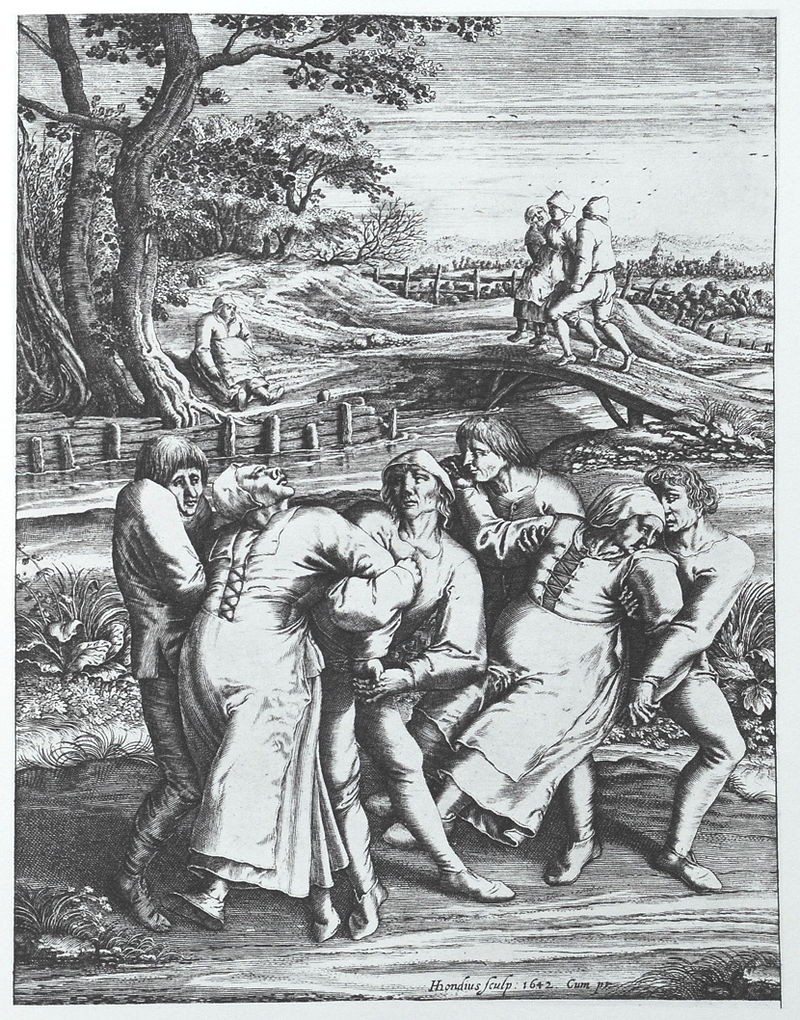
Photo: Engraving by Hendrik Hondius portrays three women affected by the plague. Work based on original drawing by Pieter Brueghel, who supposedly witnessed a subsequent outbreak in 1564 In Flanders.
The Dancing Plague, or Mania, of 1518 is one of History’s oddest events. This oddity wasn’t an isolated case, it had been seen in the 14th century, and outbreaks happened well into the 17th. While well documented, it was poorly understood at the time, with the remedies for such an odd incident being just as weird. The most famous example took place in Strasbourg, Alsace, in the Holy Roman Empire, 1518.
On a narrow street in July, a woman named Frau Troffea began to dance. This dance lasted for between four to six days. Within a week, 34 others had joined, and by the month’s end, 400. While it isn’t known why they began, the authorities tried to help as best as they knew how to. They ruled out spirits and said it was due to ‘hot blood’. They prescribed more dancing, which only worsened the situation. The ‘Plague’ vanished after a while, but what caused it remains unknown.
A popular theory on the cause is food poisoning. Ergot Fungi, which commonly grows on rye (used for baking bread) has chemicals in related to LSD. If the bread made had this in, it could explain why it happened. However, John Waller argues that it would be unlikely for everyone to be effected in the same way, and as the condition was common along the Mosel and Rhine rivers, it wouldn’t explain why it happened in places with different climates and crops.
Waller feels that high psychological distress is more likely a cause. After a succession of bad harvests, high prices, the return of leprosy and the plague and syphilis would’ve caused bitterly harsh years for the people. This mass hysteria could explain why everyone acted in the same manner, but historians still aren’t sure.
Interestingly, in Italy, a similar condition called Tarantism was recorded, While believed to be caused from a spider bite, it exhibited similar conditions, and most people said they didn’t get it from a spider, but someone who had been bitten by one. As such, they are considered synonymous by some.
Sources:
Waller (John), The crazy dancers of Strasbourg. An epidemic of collective trance in 1518
Waller, (John), A forgotten plague, making sense of dancing mania
Viegas, (Jennifer), ‘Dancing Plague’ and Other Odd Afflictions Explained
Bartholomew, (Robert), Little Green Men, Meowing Nuns and Head-Hunting Panics
Clementz, (Élisabeth), Les danseurs fous de Strasbourg. Une épidémie de transe collective en 1518
The Dancing Plague of 1518

 History Explained