
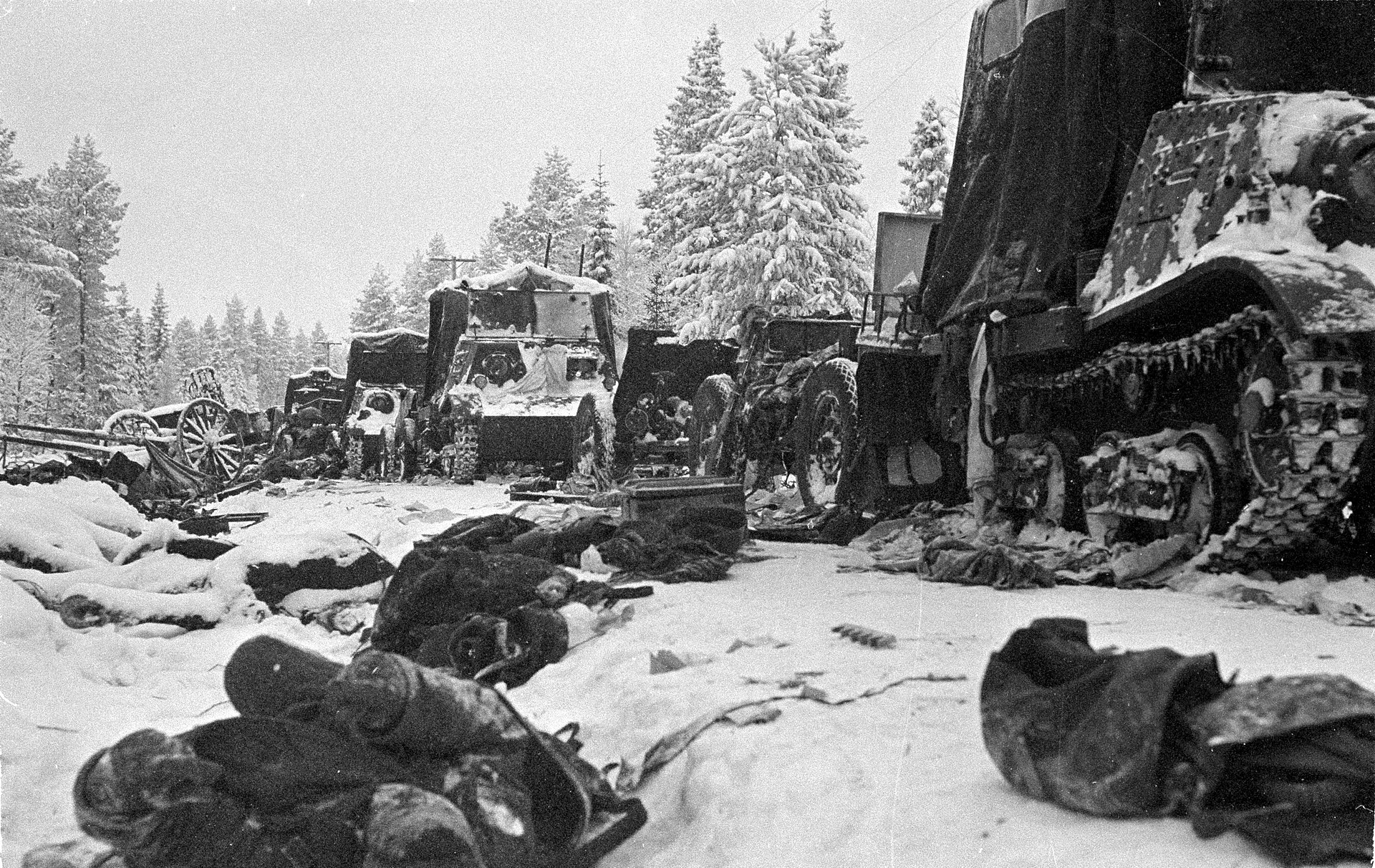
Photo: Soviet equipment and fallen soldiers at Raate Road, Suomussalmi – By the Finnish Wartime Photograph Archive
Eighty years ago today, the battle of Raate Road ended with a decisive Finnish victory.
During Talvisota,also known as the Winter War, the Soviets had captured the town of Suomussalmi. However, the 163rd Soviet Rifle Division soon found itself trapped behind Finnish lines as the Finnish captured Raate Road, a major supply line.The 163rd Division was nearly surrounded and suffered major casualties. The situation was getting worse, and on 20 December the commander of the 163rd Division, Andrei Zelentsov, asked permission to retreat. In response the 44th division, led by Alexei Vinogradov, were sent to help. Zelentsov’s concerns were not understood at the Soviet Headquarters, as the entire 44th Division was about to move along the Raate Road.
By the time the 44th arrived at the road, the Finnish 9th army, led by Colonel Hjalmar Siilasvuo, had destroyed the 163rd, and had just received orders to do the same to the 44th. The 9th were outnumbered, consisting of around 6,000 men in comparison to the 44th’s 25,000. However, the Finnish knew the land far better then the Soviets, and were more prepared.
Most of the fighting happened near Haukila, where the Finns had strong defensive positions. The main battle occurred on January 5th, in which the soviets tried using tanks to destroy the Finnish defences, ultimately unsuccessful. The Finnish army continued to divide and destroy the soviets, splitting them into smaller groups. Finally, around 9;30 PM, Vinogradov ordered a retreat across Lake Kiantajärvi.
This retreat was a disaster, as they found their route blocked by the 9th. The soviets lost a large amount of equipment, and men, but made their retreat. The soviets claimed, in a Stavka report, that only 1000 men were killed, yet Finnish estimates put this at up to 9000 killed, with around 1000 taken as prisoners of war.
For his tactics in the fight, retreat and loss of morale amongst the men, Vinogradov was court martialed and executed. Interestingly the Stavka were the ones to order the 44th to remain on the road.
As for the POW’s captured, Ukrainian Sergeant Pyotr Andrevich Morozov claimed in a 1991 interview with Finnish writer Leo Karttimo that the Finns had returned the POW’s, but none of them made it home, executed by the NKVD in the summer of 1940.
Today, the site is marked by the Winter War Monument, which has 105 brass bells, one for each day of the Winter War. The bells ring in the wind. The Winter War Monument covers 3 hectares and has around 17,000 large natural stones, which visualise the numbers and suffering of the victims of war, both Finnish and Soviet.
Sources:
Kulju, (Mika), Raatteen tie : Talvisodan pohjoinen sankaritarina
Kantakoski, (Pekka), Punaiset panssarit : Puna-armeijan panssarijoukot 1918–1945
Karttimo, (Leo), Salminen, (K. E), Rannikolta Raatteen tielle : sotaveteraanien haastatteluihin, sotapäiväkirjoihin sekä moniin muihin lähteisiin perustuva teos
Sotatieteen Laitos, Talvisodan historia
Raunio, (Ari);Kilin, (Yuri), Itsenäisyyden puolustajat: Sodan taisteluja 1. Talvisota
Campbell, (David), Finnish Soldier Vs Soviet Soldier: Winter War 1939–40

 History Explained