
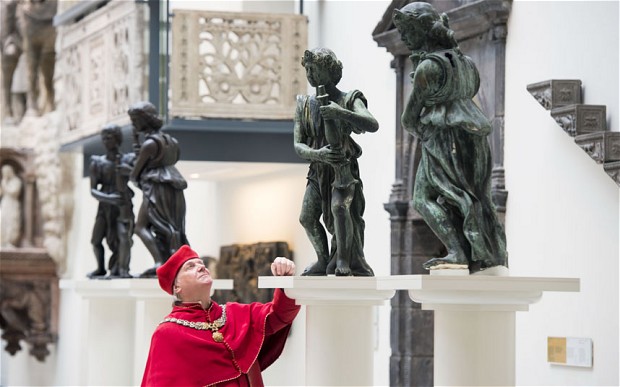
Image: Paul Jesson, dressed as Cardinal Wolsey, at the V&A museum with the Angels. Jesson played Wolsey in the stage adaption of the historical novel, Wolf Hall.
Cardinal Wolsey planned for himself an extravagant tomb, fit for a King, inside Westminster Abbey. However, when he fell from grace, Henry VIII took the tomb, it’s decoration, and Wolsey’s property and wealth. Wolsey himself was buried in Leicester, though his grave was lost, which raises the question: What happened to his extravagant tomb?
Henry took it for himself, of course. He had anything directly relating to Wolsey, such as his effigy, destroyed, though kept some artifacts, the most important being the ‘Wolsey Angels’ and the Black Sarcophagus. However, the tomb wasn’t finished in his lifetime, Henry being buried in another tomb, and most artifacts, both from Wolsey and Henry, were melted down during the English Civil War.
The Black Sarcophagus:
The sarcophagus had been commissioned in around 1524, and after Henry’s death, lay in storage for centuries, saving it from the fate of most of the artifacts. In 1806, however, it was used as the sarcophagus for Lord Nelson. However, he isn’t buried inside it, but below. In appearance, it’s identical to Wolsey’s planned one, but has Nelson’s viscount coronet on top instead of Wolsey’s Cardinal hat. The sarcophagus now resides in St. Paul’s cathedral.
The Wolsey Angels:
Four angels made by Benedetto da Rovezzano, an Italian sculptor, between 1524 and 1529. The angels, while known about, were thought to have also been melted down during the civil war. However, two of them turned up in an auction in 1994, uncatalogued. Italian Scholar, Francesco Caglioti, attributed the statues to Wolsey and Rovezzano. The other two were found in 2008, having acted as the gate guards at Harrowden Hall. In 2014, the Victoria and Albert Museum attempted to raise £5 Million to buy them, and successfully did so. The angels are on display in the V&A’s Medieval and Renaissance Galleries, after a lengthy restoration.
The Candelabra:
While not commissioned by Wolsey, instead by Henry to illuminate the tomb, they were one of the few objects known to have survived, along with the sarcophagus. The four Candelabra were acquired by the Bishop of Ghent in the 1600s, and have remained in St Bavo’s Cathedral in Belgium since then. A plaster cast of one of the candelabra was brought by the V&A museum in 1865.
Sources:
http://collections.vam.ac.uk/item/O1278467/sculpture-da-rovezzano-benedetto/
https://www.vam.ac.uk/blog/news/save-the-wolsey-angels-the-candelabrum-and-the-sarcophagus
http://www.vam.ac.uk/content/articles/w/wolsey-angels-appeal/
https://www.explore-stpauls.net/oct03/textMM/NelsonTombN.htm
Aidan McRae Thomson’s Photography – https://www.flickr.com/photos/amthomson/37196370261
The History of Wolsey’s tomb.

 History Explained